Proforma vs. Commercial Invoice: Differences, Customs & Templates
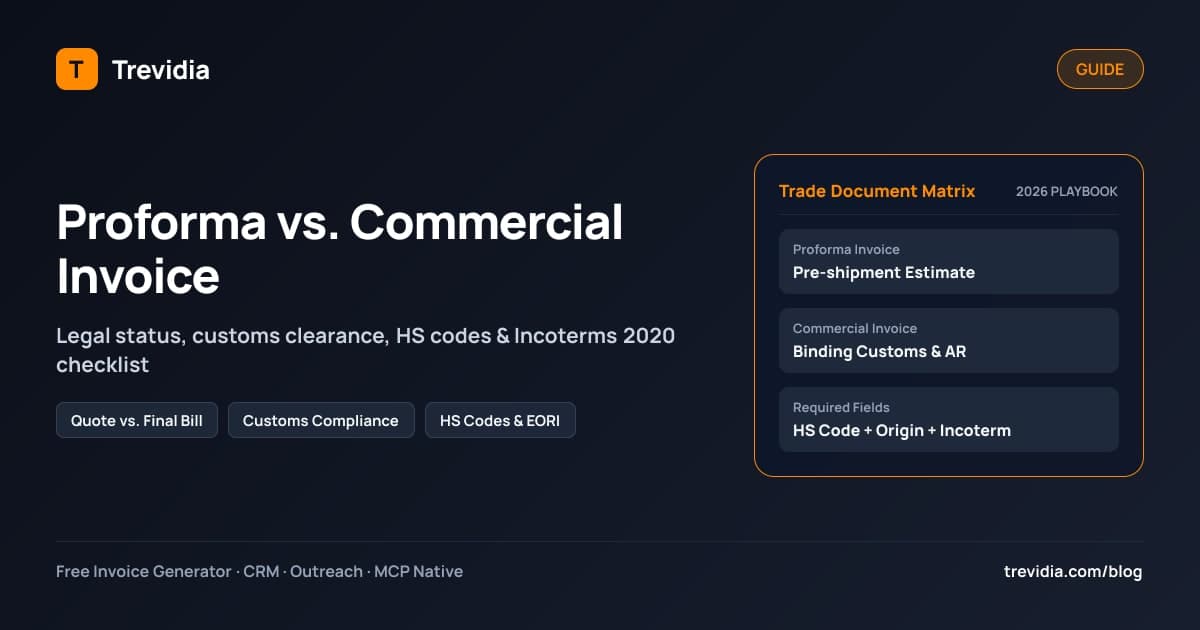
A proforma invoice is a preliminary commitment issued before goods ship or services begin so a buyer can approve budget, secure a letter of credit, or clear pre-import compliance. A commercial invoice is the legally binding demand for payment issued at delivery or shipment, recorded in accounts receivable and required by customs brokers to calculate duties and taxes.
Sending the wrong document stalls cash flow on two fronts: customs officers hold shipments sent with a proforma, and accounting teams book phantom revenue when teams treat proformas like final bills. Understanding where each document sits in the order-to-cash cycle keeps cross-border shipments moving and keeps your books audit-ready.
Proforma Invoice vs. Commercial Invoice: Side-by-Side Comparison
Every business that ships physical products internationally, bills enterprise procurement departments, or collects upfront deposits needs a sharp line between preliminary documentation and final accounting records.
| Dimension | Proforma Invoice | Commercial Invoice |
|---|---|---|
| Timing in workflow | Issued after buyer interest and before production, shipment, or onboarding | Issued upon shipment, delivery, or completed milestone |
| Legal & accounting status | Non-binding commitment; never recorded in Accounts Receivable (AR) | Legally binding financial claim; recorded in AR and general ledger |
| Tax point (VAT / GST / Sales Tax) | Does not establish a statutory tax point in most jurisdictions | Triggers VAT, GST, or sales tax reporting and input tax credit claims |
| Customs clearance role | Used only for pre-import licenses, currency controls, or sample valuation | Mandatory primary document for customs valuation, HS tariff duty, and clearance |
| Numbering sequence | Prefixed separately (e.g., PF-2026-041) to protect tax sequence integrity |
Strict sequential invoice number (e.g., INV-2026-1042) with no gaps |
| Cancellation process | Expires automatically or updates via revised proforma; no credit note needed | Requires a formal credit note or void log to reverse in accounting |
| Best template to start | Free Proforma Invoice Template | Free Commercial Invoice Template |
If your business mixes domestic service billing with physical product exports, pair this comparison with our breakdown of what needs to be on a US invoice so every domestic and cross-border template meets local rules.
Proforma vs. Quote vs. Purchase Order vs. Commercial Invoice
Teams frequently blur four pre- and post-sale documents. Keeping their sequence straight eliminates procurement back-and-forth with corporate AP departments:
- Estimate or Quote (Seller -> Buyer): Exploratory pricing with variable scope options before the buyer commits to buying.
- Purchase Order / PO (Buyer -> Seller): The buyer's formal authorization to purchase specific SKUs, quantities, and rates under an approved budget number.
- Proforma Invoice (Seller -> Buyer): A structured pre-shipment invoice reflecting exact agreed terms, Incoterms, freight, and deposit instructions—often required before a bank issues a Letter of Credit (L/C) or before an overseas buyer can wire USD out of strict foreign-exchange jurisdictions.
- Commercial Invoice (Seller -> Buyer & Customs): The final, immutable bill reflecting the exact goods packed, shipped, and delivered.
Notice why numbering matters here. Never pull a number from your sequential INV- series for a proforma document. If the deal changes or cancels before shipment, a skipped sequential invoice number creates an audit flag during VAT or corporate tax reviews. Keep a dedicated PF- prefix, and inspect our complete invoice numbering systems guide to standardize both series.
The 6-Step Order-to-Cash Workflow Across Borders
Follow this operational sequence whenever a buyer asks for formal pricing before goods leave your warehouse or before a multi-month retainer kicks off:
Step 1: Confirm Buyer Details, Currency, and Incoterms 2020
Lock in whether the seller or buyer pays freight, marine insurance, and import duties. Under Incoterms 2020, choosing EXW (Ex Works), FOB (Free on Board), CIF (Cost, Insurance, and Freight), or DDP (Delivered Duty Paid) directly alters the total on your proforma and determines which customs broker handles import clearance.
Step 2: Issue a Clearly Labeled Proforma Invoice (PF-)
Place PROFORMA INVOICE prominently in the document header alongside an explicit validity window (such as 15 or 30 days) and a non-binding disclaimer: "Proforma invoice for budget approval and customs pre-clearance only; not a tax invoice or demand for final payment." Include accurate preliminary weights, HS tariff codes, and bank wire instructions using a clean proforma invoice template.
Step 3: Collect Deposit or Letter of Credit Authorization
When terms require a 30% or 50% upfront wire before manufacturing or onboarding, book that incoming cash to a Customer Deposits / Unearned Revenue liability account rather than sales revenue. Only convert that liability to earned revenue when the final commercial invoice issues.
Step 4: Pack, Verify Exact Quantities, and Finalize HS Codes
Short shipments, backorders, or weight adjustments happen regularly on warehouse floors. Your commercial invoice must match the Packing List and Bill of Lading / Air Waybill unit-for-unit. If a buyer ordered 500 units on the proforma but 480 shipped in Carton 1–24, the commercial invoice must bill strictly for 480 units.
Step 5: Generate the Final Commercial Invoice (INV-)
Convert the approved proforma into a numbered commercial invoice—never edit the proforma word-for-word without incrementing to your official invoice sequence and signing the export declaration. You can learn more about selecting export-ready layouts in our guide to choosing the right commercial invoice template.
Step 6: Sync Receivables, Taxes, and Fees Into Accounting
Once the final invoice issues and payment settles, ensure the invoice, line items, taxes, and payment processor fees reconcile cleanly with your general ledger. Inside Trevidia, verified merchants link receivables directly to QuickBooks Online two-way sync so paid commercial or service invoices post automatically without manual CSV exports.
Mandatory Customs Fields Every Commercial Invoice Must Include
Border brokers hold freight—and charge daily demurrage or storage fees—whenever a single customs field is missing. Verify every field below before handing your packet to DHL, FedEx, UPS, or a freight forwarder:
| Field Group | Mandatory Elements | Why Customs Requires It |
|---|---|---|
| Exporter & Importer IDs | Legal names, physical addresses, phone numbers, Tax ID / EIN / EORI number (EU/UK) | Identifies the Importer of Record (IOR) liable for duties and recalls |
| Invoice Metadata | Unique commercial invoice number, issue date, PO reference, currency (ISO 4217 e.g., USD, EUR) |
Matches declared transaction value against bank wire audits |
| Itemized Goods | Plain-English product description (never vague labels like "parts" or "samples"), SKU, unit count, unit price, extended total | Enables valuation verification without physical carton opening |
| HS / HTS Tariff Code | 6-digit international Harmonized System code + 8–10 digit destination tariff suffix | Determines the exact import duty rate and regulatory holds |
| Country of Origin | Country where goods were manufactured or substantially transformed (per item) | Applies preferential trade-agreement rates or anti-dumping tariffs |
| Incoterm 2020 & Breakdown | Stated Incoterm + named port/city, itemized freight, insurance, and packaging costs | Prevents customs from taxing freight twice or over-assessing ad valorem duty |
| Export Declaration & Signature | Signed statement certifying truth and accuracy, printed name, title, and date | Required legal attestation under export control laws |
For businesses billing VAT or GST alongside cross-border services or mixed shipments, pair these fields with our US, UK, EU & Canada tax invoice requirements guide and start from a compliant tax invoice template.
Worked Example: Converting a Proforma Into a Final Commercial Invoice
Suppose an Austin-based lighting hardware supplier ships 200 commercial LED fixtures to an interior design studio in London under CIF London Gateway terms.
Stage A — Proforma Invoice (PF-2026-019)
- Valid Until: November 15, 2026
- Line 1: Architectural Linear LED Fixture 48" (SKU
LED-48-BK, HS9405.11.60, Origin: USA) —200 units × $145.00 = $29,000.00 - Line 2: International Air Freight & Crate Packaging —
$1,850.00 - Line 3: Marine Cargo Insurance (CIF coverage) —
$320.00 - Proforma Total (USD):
$31,170.00 - Deposit Terms: 40% (
$12,468.00) due prior to assembly; 60% balance due prior to final release.
Stage B — Final Commercial Invoice (INV-2026-0844)
During final QC, 10 units fail color-temperature testing, so the supplier ships 190 units immediately with client approval. The commercial invoice updates cleanly:
- Reference:
Proforma PF-2026-019 | PO #LON-772 - Exporter EORI / EIN: Included in header
- Importer EORI / UK VAT: Included in Sold To / Ship To block
- Line 1: Architectural Linear LED Fixture 48" (HS
9405.11.60, Origin: USA) —190 units × $145.00 = $27,550.00 - Line 2: International Air Freight & Crate Packaging —
$1,810.00 - Line 3: Marine Cargo Insurance —
$305.00 - Subtotal / CIF Customs Value:
$29,665.00 - Less Prepayment Received (PF-2026-019):
-$12,468.00 - Net Balance Due:
$17,197.00
Notice how keeping the prepayment visible on the commercial invoice preserves both the full customs value ($29,665.00)—which UK customs requires regardless of prepayments—and the net cash balance due ($17,197.00) for the buyer's AP clerk. Showing only the net balance as the commercial value is one of the fastest ways to trigger a customs audit hold.
Five Expensive Mistakes That Trigger Border Holds and Payment Delays
- Labeling a commercial shipment "No Commercial Value" ($0): Even promotional samples and replacement warranty parts hold fair market or manufacturing value for customs. Declare realistic wholesale cost and add "Value for customs purposes only — free replacement parts."
- Omitting the separate "Ship To" vs. "Bill To" distinction: When a distributor in Toronto buys goods delivered directly to a warehouse in Rotterdam, failing to separate the billed entity from the physical consignee causes immediate VAT and broker rejection.
- Writing generic product names: Descriptions like
"Electronics","Hardware", or"Merchandise"fail automated customs risk screening. Always list material, function, and unit specs (e.g.,"Anodized aluminum tripod mounts for studio cameras"). - Using inconsistent currencies across documents: If your proforma quotes EUR, your wire instructions settle in USD, and your commercial invoice lists GBP without stating the fixed conversion rate, reconciliation breaks down.
- Releasing goods before high-ticket card or wire checks clear: For online invoice payments on high-value custom orders, verify buyer identity and enforce 3D Secure before shipping inventory. See our invoice chargeback and payment fraud prevention playbook for step-by-step checkout guardrails.
How to Issue Proforma and Commercial Invoices Faster in Trevidia
Switching between Word docs, freight spreadsheets, and separate billing tools creates copy-paste errors across HS codes, quantities, and totals. Trevidia replaces scattered templates with a unified invoicing, CRM, and client payment workspace starting on a $0/month Free Core OS (up to 5 invoices per month free, plus 50 free Claude AI starter credits).
With Trevidia, you can:
- Start with structured templates: Generate pixel-perfect PDFs using Standard or Editorial layouts, or start directly from downloadable Word, Excel, and Google Docs templates.
- Automate tax, discount, and shipping math: Separate freight, cargo insurance, item quantities, and regional tax rates accurately without broken spreadsheet formulas.
- Add dual digital signatures and QR payment links: Collect signed buyer acknowledgment on estimates or proformas and give clients a clean online checkout link once final invoices issue.
- Protect high-value invoice payments: For verified workspaces accepting online card payments via Invoicing Pro ($9/month on modular pricing), Trevidia enforces Server-Finalized Confirmation Tokens with mandatory 3D Secure and a 7–14 day escrow maturation window—eliminating negative balance surprises on disputed high-ticket orders.
- Sync cleanly to QuickBooks Online: Keep final commercial invoices, customer profiles, payments, and processing fees reconciled automatically without recording unbilled drafts into revenue.
Ready to eliminate border delays and billing disputes? Create your free Trevidia workspace in two minutes or test our downloadable proforma and commercial invoice templates today.
Pre-Send Verification Checklist
- Document title clearly reads PROFORMA INVOICE (preliminary) or COMMERCIAL INVOICE (final customs & AR).
- Numbering uses separate prefixes (
PF-vs.INV-) with zero gaps in your official tax invoice series. - Exporter and Importer legal names, addresses, phone numbers, and Tax/EORI/VAT IDs are verified.
- Every line item includes a plain-English description, 6–10 digit HS tariff code, and country of origin.
- Incoterms 2020 (with named port/city), freight, and insurance are itemized separately.
- Total customs value reflects full transaction value even when a deposit is deducted from net balance due.
- Commercial invoice matches the Packing List and Air Waybill / Bill of Lading unit-for-unit before dispatch.