How to Prevent Invoice Chargebacks & Payment Fraud (2026 Playbook)
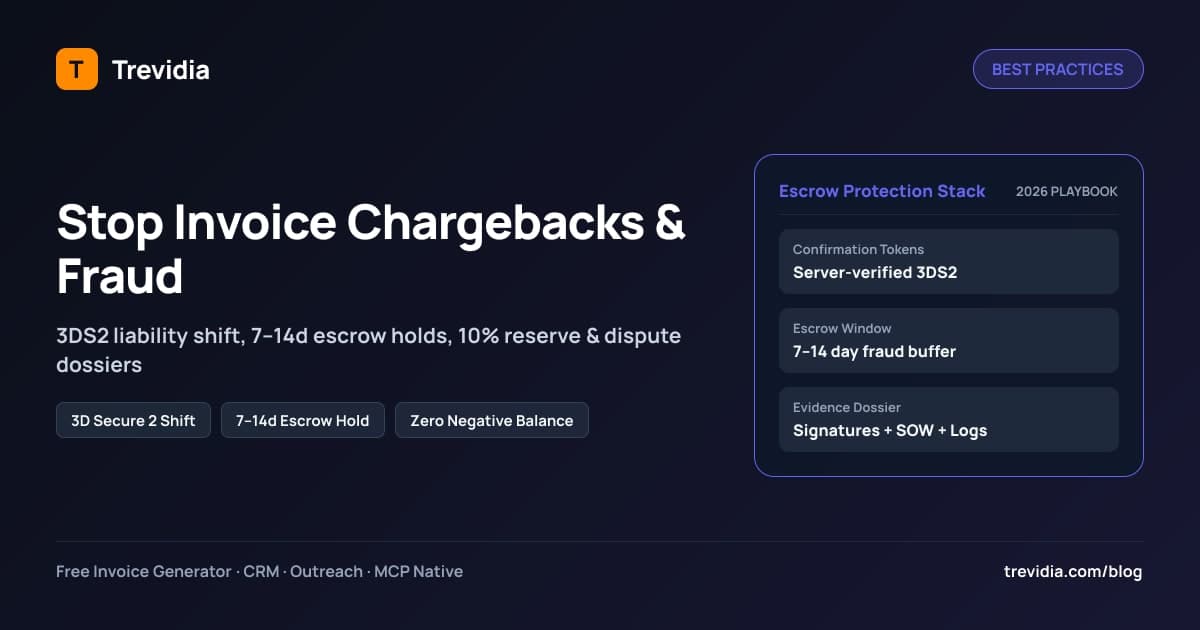
An invoice chargeback happens when a payer's card-issuing bank forcibly reverses a settled invoice payment after the cardholder claims unauthorized use, non-delivery, or service dissatisfaction—deducting the full principal plus a dispute fee before you ever present evidence. Preventing these losses requires combining 3D Secure 2 (3DS2) authentication, server-side velocity & risk screening, 7–14 day escrow hold windows, and signed delivery evidence before cash leaves the platform.
Too many freelancers and agencies assume "Paid" means cash is permanently safe. In reality, B2B dispute windows routinely stay open for 60 to 120 days after payment. Without structured checkout and escrow guardrails, one disputed $8,000 invoice can freeze your entire payout flow or wipe out months of margin.
True Fraud vs. Friendly Fraud vs. Scope Disputes
Every invoice dispute falls into one of three distinct buckets—each requiring a completely different defensive layer:
| Dispute Type | What Actually Happened | Card Network Reason Codes | Primary Defense |
|---|---|---|---|
| 1. True Stolen-Card Fraud | A bad actor used stolen card credentials or launched an emergency overpayment scam on an open invoice link | 10.4 Other Fraud (Visa), 4837 No Cardholder Authorization (MC) |
Mandatory 3DS2, KYC before accepting cards, IP/country checks, Radar Early Fraud Warnings |
| 2. First-Party ("Friendly") Fraud | The real client authorized the project, received deliverables, and later disputed the card charge claiming "unrecognized" or "never received" | 13.1 Merchandise/Services Not Received, 10.4 |
Signed SOW, dual digital signatures on invoice, 3DS2 auth log, Visa Compelling Evidence 3.0 |
| 3. Quality / Scope Misalignment | The client claims deliverables missed agreed specs or timeline expectations and pulls funds back instead of negotiating | 13.3 Not as Described / Defective Service |
Milestone sign-off emails, explicit revision caps, documented change orders, clean refund SLA |
Notice a hard reality across all three rows: winning a dispute after the fact is slow and uncertain, whereas blocking unauthenticated or unverified transactions upfront prevents the chargeback entirely.
Why 2-Day Automatic Payouts Create Negative Balance Risks
Most legacy invoicing tools turn on instant or 2-day automatic payouts by default. That architecture breaks down under real-world fraud timelines:
- Day 0: A compromised card—or a high-risk unverified merchant issuing fake invoices—processes
$7,500via an unauthenticated checkout link. - Day 2: Automatic payouts sweep
$7,250straight into an external bank account. - Day 11: The card-issuing bank triggers a
radar.early_fraud_warning.createdevent or formal dispute (charge.dispute.created). - Day 12: The bank immediately pulls
$7,500 + dispute feeback from the payment ledger—leaving the account negative-$7,525because the bank account was already drained.
Even legitimate agencies get caught in the crossfire when a disgruntled buyer initiates a chargeback on Day 18 after a sudden project cancellation. Holding funds safely inside a platform escrow ledger during the highest-risk 7–14 day window—before dispensing cash—protects both platforms and verified merchants from cascading negative balances, clawbacks, and sudden processor shutdowns.
Trevidia's 4-Layer Zero-Fraud Invoice Checkout & Escrow Architecture
Instead of trusting unverified accounts or running blind auto-payouts, Trevidia enforces an institutional-grade payment defense across every online invoice transaction (detailed in our architecture design):
| Defense Layer | How It Works Technically | Fraud Vector Neutralized |
|---|---|---|
1. Internal KYC Gate (KYC_SUBMISSIONS) |
Before any workspace accepts live card payments on invoices, owners submit Government ID, selfie liveness, business registration/tax docs, and bank verification for manual /admin approval and Risk Tier assignment (Tier 1, Tier 2, Tier 3). |
Stops shell accounts, merchant bust-out schemes, and synthetic invoice fraud at onboarding |
| 2. Server-Finalized Confirmation Tokens + 3DS2 | Browser <PaymentElement /> collects card inputs and sends a ConfirmationToken to our NestJS engine, which checks card country, CVC, fingerprint, and daily velocity limits before enforcing request_three_d_secure: 'any' server-side. |
Blocks card-testing bots and shifts unauthorized-use fraud liability to issuing banks via 3DS2 |
| 3. 7–14 Day Escrow Hold + 10% Rolling Reserve | Settled funds credit pending_escrow_balance for 7–14 days (clears_at), alongside a 10% rolling reserve (rolling_reserve_balance). If an Early Fraud Warning hits during hold, the payment refunds cleanly from escrow with zero negative balance. |
Neutralizes post-payment stolen-card reversals and early disputes before cash leaves the platform |
4. Controlled Cash Dispensing (PAYOUT_REQUESTS) |
Once hold windows clear with zero open risk events (PAYMENT_RISK_EVENTS) and delivery/signature checks pass, merchants withdraw cleared funds from available_for_payout_balance via controlled payout approval. |
Eliminates surprise processor freezes and guarantees every dispensed payout is settled and clean |
This zero-negative-balance framework pairs naturally with written contract terms. Read how to write a freelance contract that protects your business so your legal scope reinforces your technical payment controls.
Never Accept "Overpayment + Refund the Difference" Invoice Scams
B2B service providers and contractors face one specific social-engineering fraud wave repeatedly:
- A "new client" approves a
$4,000consulting or design quote unusually quickly—often without requesting a video discovery call. - They claim their accounting team accidentally paid
$9,000(or asks you to charge$9,000and wire$5,000to "their third-party print vendor / logistics shipper"). - Five days after you wire
$5,000to their accomplice, the original$9,000card charge bounces back as stolen-card fraud—costing you both the$5,000outgoing wire and the$9,000reversal.
Strict Operational Rule: Never process extra funds on a client's behalf or refund an overpayment to a different card, bank account, PayPal, or wire destination. Always refund overpayments exclusively back onto the exact original payment method through your payment dashboard—or issue a voided transaction before settlement.
7-Item Compelling Evidence Dossier That Wins Invoice Disputes
When an unfair friendly-fraud chargeback does hit, you typically have 7 to 21 calendar days to submit a crisp PDF evidence packet (keep it factual, indexed, and under card network page limits). Collect these seven artifacts during every project so assembling a winning response takes 10 minutes:
- Signed Proposal / Statement of Work (SOW): PDF showing scope, pricing, milestone schedule, refund/cancellation terms, and client signature with timestamp and signer IP.
- Dual-Signed Invoice Copy: Your professional invoice template showing both your authorized signature and the client's counter-signature, itemized services, and matching dollar amount.
- 3D Secure / AVS / CVC Verification Record: Payment receipt proving 3DS2 challenge passed, billing ZIP matched (AVS), and CVC validated.
- Live Video Call & Identity Trail: Calendar invite or Google Meet booking confirmation matching the buyer's verified corporate email domain (
@clientcompany.com, not throwaway free mail). - Proof of Service Delivery: Git commit merge logs, staging URL access timestamps, Google Drive / Figma download audit logs, tracking numbers (for physical goods), or signed completion certificates.
- Client Acceptance Communications: Exported email or Slack screenshots showing the client acknowledging receipt (e.g., "Thanks, design v2 approved—we're launching Monday"), which dismantles "Merchandise/Services Not Received" claims.
- Clear Refund & Dispute Policy Disclosure: Screenshot showing your refund/cancellation terms visible prior to checkout confirmation.
Keep all project billing, call logs, and email approvals attached to a single client record. In Trevidia CRM, client contact cards unify email threads, Google Meet logs, activities, and linked invoices—so gathering dispute evidence never requires digging across five separate inboxes.
Pre-Checkout Risk Matrix for High-Ticket Invoices ($2,500+)
Before sending an open card checkout link on a sizable first-time engagement, score the payer across five verification signals—especially when a buyer arrives cold without an established referral:
| Risk Signal | Green Light (Proceed Normally) | Yellow Flag (Require Extra Verification) | Red Flag (Require ACH/Wire or Cancel) |
|---|---|---|---|
| Payer Email & Domain | Active corporate domain matching buyer website & LinkedIn profile | Free Gmail/Yahoo tied to an established sole proprietor | Newly registered throwaway domain or mismatched display name |
| Card Country vs. Billing IP | Card issuer country, billing ZIP, and checkout IP align | Remote founder traveling abroad with valid 3DS2 bank push | High-risk mismatch + VPN/proxy exit node + multiple failed card retries |
| Ticket Size Velocity | Matches prior historical project size ($1K–$5K) |
Jump of 3x+ over usual client spend without SOW milestone |
Multiple rapid split card payments ($1,999 × 4) trying to dodge single-charge caps |
| Discovery & Contract Trail | Live Google Meet call logged + signed SOW + verified billing contact | Async email-only approval with verified LinkedIn handle | Refuses live call, rushes payment link, or requests third-party vendor forwarding |
| Payment Method | 3DS2 authenticated card or verified ACH bank transfer | Non-3DS international corporate card | Requests split cards or third-party overpayment refund |
Step-by-Step Chargeback Rebuttal Structure (When You Must Fight One)
If a client files a dispute despite clean delivery, structure your evidence cover sheet so a card-network analyst can decide in your favor within 90 seconds of reading Page 1:
- One-Page Executive Summary Header: State Merchant Name, Invoice Number (
INV-2026-0844), Transaction Date, Disputed Amount, 3DS2 Authentication Status (Authenticated — ECI 05), and the exact Reason Code (13.1 Services Not Receivedor10.4 Fraud). - Chronological 5-Bullet Delivery Timeline: List
Date signed SOW->Date deposit paid->Date live Google Meet kickoff->Date deliverables uploaded & accessed->Date client confirmed acceptance in email. - Labeled Exhibits (
Exhibit AthroughExhibit E): Attach clean, highlighted screenshots rather than dumping 45 unindexed raw PDF pages—circle matching client names, domains, IP matches, and acceptance quotes cleanly.
How to Reduce Legitimate Client Billing Friction Before It Turns Into a Dispute
Many B2B chargebacks happen because an executive forgets what a STRIPE* TRV line on their Amex statement represents, or because an invoice changed scope mid-project without warning:
- Use crisp, recognizable statement descriptors & company names: Ensure your legal DBA name matches the business name on your signed SOW and invoice PDF header.
- Separate deposits and change orders cleanly: Follow our Net 15 vs. Net 30 vs. Net 60 payment terms guide and never surprise a client with unapproved add-on hours on a final bill.
- Offer a fast, clear escalation path: Put
Questions about this invoice? Email billing@yourcompany.com for a 24-hour reviewright below the payment link. Clients open bank disputes when sellers ignore emails; read how to handle late invoice payments for calm resolution scripts. - Reconcile immediately: Sync paid invoices, deposits, and processing fees two-way into accounting so partial refunds or adjustments never slip past your finance team.
Start Protected Invoicing on Trevidia Free Core OS
Protecting revenue against fraud shouldn't require enterprise software fees. Start on Trevidia's $0/month Free Core OS (up to 5 free PDF invoices/month, full CRM, and 50 Claude AI credits) or upgrade to Invoicing Pro ($9/month) for unlimited invoicing, recurring billing, Editorial templates, QuickBooks Online sync, and full escrow-protected Confirmation Token card checkout.
Create your free workspace or explore our service invoice templates to build fraud-resilient client billing today.
Invoice Fraud & Chargeback Prevention Checklist
- Internal KYC verification completed before enabling live online card payments on invoices.
- All card payments enforce 3D Secure 2 (3DS2) authentication and velocity limits.
- High-risk or first-time corporate orders verify buyer corporate domain via live Google Meet discovery call.
- Statement of Work and invoice both carry client signatures and matching itemized scope.
- Zero third-party "overpayment + wire difference" requests ever accepted.
- Proof of delivery (file logs, email approvals, tracking IDs) stored directly inside the client's CRM timeline.
- Refund/cancellation policy displayed clearly on every professional invoice template before payment.