Net 15 vs. Net 30 vs. Net 60: Best Invoice Payment Terms Guide
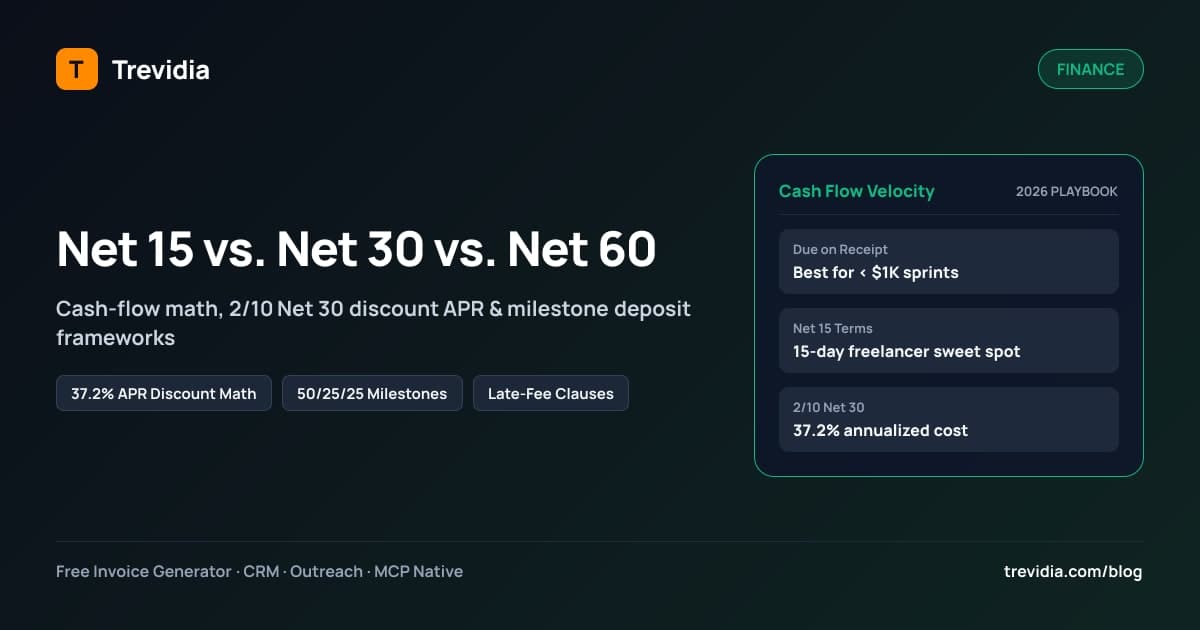
Invoice payment terms specify the exact calendar deadline a client has to pay your bill after issue: Net 15 requires payment within 15 calendar days, Net 30 within 30 days, and Net 60 within 60 days. Defaulting to Net 30 simply because corporate templates use it quietly forces freelancers and lean agencies to act as interest-free banks for their clients.
Picking the right term depends on deal size, client AP complexity, and your operating cash buffer. Below is the exact math comparing every major payment schedule, when early-payment discounts backfire, and copy-paste terms clauses you can drop straight onto your next freelance invoice template.
Payment Terms Comparison Matrix: Speed, Risk & Best Fit
Before printing terms on your invoice, compare how each standard window affects cash arrival and client pushback:
| Payment Term | Due Window | Typical Client Fit | Working Capital Impact | Best Use Case |
|---|---|---|---|---|
| Due on Receipt (DOR) | Immediately upon delivery (0 days) |
Startups, solopreneurs, SMBs, retainers | Fastest cash velocity; minimal AR aging | One-off deliverables under $2,500 or pre-billed monthly retainers |
| Net 7 / Net 10 | 7 or 10 calendar days | Growth-stage companies using automated bill pay | High liquidity; catches two ACH clearing windows | Weekly contractors, sprint work, recurring software/marketing retainers |
| Net 15 | 15 calendar days | Mid-market firms & agencies | Balanced: halves Net 30 wait time | Default recommended term for consultants, designers, and service studios |
| Net 30 | 30 calendar days | Mid-to-large B2B corporations | Moderate cash drag; requires 1–2 months runway | Established enterprise contracts with approved Purchase Orders (POs) |
| Net 60 / Net 90 | 60 or 90 calendar days | Fortune 500, government, healthcare procurement | Severe cash drain without upfront deposits | High-ticket enterprise deals paired with 40–50% kickoff deposits |
| 2/10 Net 30 | 2% off if paid by Day 10; full by Day 30 | Cash-rich buyers seeking vendor margin | High hidden financing cost (37.24% APR) |
High-margin projects where Day-10 liquidity replaces credit line interest |
Note one crucial distinction: "Net" always refers to calendar days from the invoice issue date, not the date the client finally opens the email or approves the purchase order internally. Always stamp both the explicit Issue Date and Due Date (e.g., Due Date: November 16, 2026) on every bill—never write "Net 15" without calculating the actual calendar date for the payer.
Cash-Flow Math: How Net 15 vs. Net 30 vs. Net 60 Hits a $10,000/Month Agency
To see why payment terms govern survival even for profitable agencies, model a lean B2B consultancy billing $10,000/month with $6,500/month in fixed payroll, contractor, and software expenses. Assume bills issue on the 1st of each month starting January 1:
| Scenario | Month 1 Cash In | Month 2 Cash In | Month 3 Cash In | Peak Cash Deficit Before Equilibrium |
|---|---|---|---|---|
| Net 15 | $10,000 (Jan 16) |
$10,000 (Feb 16) |
$10,000 (Mar 16) |
$0 if rent/payroll clear mid-month; max ~$3,250 timing gap |
| Net 30 | $0 (due Jan 31) |
$10,000 (Feb 1) |
$10,000 (Mar 3) |
-$6,500 cash deficit during all of Month 1 |
| Net 60 | $0 |
$0 |
$10,000 (Mar 2) |
-$13,000 cash deficit across Months 1 and 2 |
When that agency grows from $10,000/month to $25,000/month and hires a second contractor under Net 60 terms, accounts receivable balloons to $50,000 in unpaid work before Month 3's first check arrives. Rapid growth under slow payment terms is the #1 reason profitable service firms run out of cash.
If you run recurring retainers, pairing shorter terms like Due on Receipt or Net 7 with automated scheduling eliminates manual chasing altogether. Read our walkthrough on setting up recurring invoices on autopilot to turn monthly retainers into predictable day-one cash.
The Hidden Math Behind 2/10 Net 30 Early-Payment Discounts
Corporate procurement teams love asking vendors for 2/10 Net 30 terms (a 2% discount if paid within 10 days, otherwise full balance at Day 30). On paper, 2% looks tiny. In annualized financing terms, it is extraordinarily expensive.
Calculate the annualized interest rate (APR) you effectively pay for receiving cash 20 days early (30 - 10 = 20 days):
Effective APR = [ Discount % / (100% - Discount %) ] × [ 365 / (Net Days - Discount Days) ]
Plug in 2/10 Net 30:
Effective APR = (0.02 / 0.98) × (365 / 20) = 0.020408 × 18.25 = 37.24%
Compare 37.24% APR against typical small-business credit costs:
- 1/10 Net 30:
0.01 / 0.99 × (365 / 20) = 18.43% APR - 2/15 Net 45:
0.02 / 0.98 × (365 / 30) = 24.83% APR - 2/10 Net 60:
0.02 / 0.98 × (365 / 50) = 14.90% APR
Operational Rule: Never offer 2/10 Net 30 if your net profit margin is under 25% or if you have access to cheaper working capital. If you want fast payments without giving away 37% annualized margin, bake a 3% convenience buffer into your proposal first, or use 50/25/25 milestone billing instead.
The 50/25/25 Deposit & Milestone Framework for Larger Projects
Whenever a fixed-scope project exceeds $3,000 or spans more than three weeks, replace single end-of-project Net 30 invoices with staged milestones:
- 50% Kickoff Deposit (Due on Receipt): Reserves your calendar and funds initial discovery/architecture work. Work does not start until the deposit clears.
- 25% Mid-Point Delivery (Net 7 or Net 15): Tied to a concrete, objective artifact (wireframe sign-off, staging deployment, or draft manuscript delivery)—never subjective "client happiness."
- 25% Final Launch / Handover (Net 15 or Due Before Final Asset Transfer): Admin credentials, source files, or production keys transfer immediately upon settlement.
For advisory retainers, switch cleanly to 100% upfront monthly billing due on the 1st of the service month (e.g., April's retainer paid April 1 via card or ACH) using a structured consulting invoice template. Once clients agree to upfront retainers during contracting, late-payment friction drops dramatically.
How to Negotiate Down From Enterprise Net 60 or Net 90 Terms
Large enterprise procurement portals routinely present "Standard Vendor Terms: Net 60" as non-negotiable policy. In practice, AP departments bend far more often than freelancers expect when you negotiate with clear trade-offs:
- Swap 60-day wait for an upfront deposit: "Our standard project rate requires 50% upon SOW signature (Due on Receipt) and 50% at completion on Net 30. If your finance policy strictly mandates Net 60 on final invoices, we keep the 50% kickoff deposit so our team can allocate full capacity."
- Offer Net 15 for ACH / online card checkout: Many enterprise portals hold paper checks for 45–60 days while automated Stripe/ACH portals settle in Net 15. Ask whether vendor onboarding via electronic ACH qualifies for accelerated payment runs.
- Price the financing float into the quote: If a Fortune 500 buyer genuinely cannot adjust Net 60 terms in their ERP, accept Net 60 while increasing your project fee by
4%–6%before submitting the final proposal. - Clarify the "Clock Start" trigger: Make sure Net 30 starts on invoice submission, not "acceptance testing" or "end-of-month batch close"—which silently turns Net 30 into Net 58.
Make sure every payment concession lives inside your written agreement before kickoff. Review our guide on writing a freelance contract that protects your business for exact kill-fee and suspension clauses.
4 Copy-Paste Invoice Payment Terms & Late-Fee Clauses
Paste the clause matching your engagement directly into the Notes/Terms box on your service invoice template and mirror it inside your Statement of Work:
1. Standard Freelancer & Retainer Clause (Net 15 + Late Fee)
Payment Terms — Net 15: Payment in full is due within fifteen (15) calendar days of the invoice issue date (
Due Datestated above). Payments accepted via ACH, bank transfer, or secure card checkout. Balances unpaid beyond the due date accrue a late fee of 1.5% per month (or the maximum rate permitted by applicable law), and ongoing project work pauses after 7 days past due.
2. Project Milestone Deposit Clause (50/25/25)
Milestone Billing Schedule: This invoice covers Milestone [1/2/3] per Statement of Work #[Number]. Kickoff deposits are Due on Receipt prior to work commencement. Subsequent milestone invoices are due Net 7; final deliverable handoff and source file licensing transfer upon full settlement.
3. Enterprise PO & Electronic ACH Clause (Net 30)
Enterprise Payment Terms — Net 30: Payment is due thirty (30) calendar days from the electronic delivery date of this invoice referencing PO #[Number]. Please remit via ACH or online card link to avoid mailroom check-clearing delays. Disputed line items must be reported in writing within 7 business days; undisputed balances remain due on the original due date.
4. Early-Payment Incentive Clause (1/10 Net 30)
Optional Early Settlement Discount (1/10 Net 30): A 1% discount may be deducted only if full payment settles within ten (10) calendar days of the issue date. Payments remitted on Day 11 or later require 100% of the gross invoice total by Day 30.
If a client already slipped past the due date, escalate cleanly using our templates in how to handle late invoice payments rather than writing emotional follow-ups.
Automate Due-Date Tracking & Online Payments in Trevidia
Writing clear payment terms only helps if clients can pay cleanly the moment they open the email—and if reminders fire automatically when someone forgets. Trevidia ties clear payment terms directly to online checkout and automated follow-up:
- Start free at $0/month: Issue up to 5 branded PDF invoices monthly on the Free Core OS (including 50 AI credits to polish line-item scopes with Claude AI in 1 credit per run).
- Show clear Issue Date, Due Date, and PO fields: Eliminate "when was this due?" excuses across domestic and international clients.
- Accept 3D-Secure card payments with escrow protection: On Invoicing Pro ($9/month on Trevidia pricing), verified workspaces embed instant
<PaymentElement />card checkout links protected by 3D Secure and a 7–14 day escrow hold window—reducing chargeback headaches while giving clients frictionless 1-click settlement. - Sync every invoice and payment to QuickBooks Online: Track unpaid AR aging and settled fees automatically without reconciling spreadsheets by hand.
Create your free Trevidia workspace today and replace vague "pay when ready" bills with crisp, fast-settling payment terms.
Payment Terms Pre-Send Checklist
- Explicit Issue Date and calculated calendar Due Date appear clearly at the top of the invoice.
- Payment terms on the invoice match the signed contract or SOW word-for-word.
- Large projects (
>$3,000) require a Due on Receipt deposit before kickoff. - Any early-payment discount (
2/10 Net 30) has been margin-checked against its 37.24% APR cost. - One-click electronic payment instructions (ACH details or online card link) are attached so AP doesn't default to slow paper checks.
- Automated polite reminders are scheduled for
T - 3 days,Due Date, andT + 7 days overdue.